

How to Trim Cat Nails: A Calm Step-by-Step Guide
How to trim cat nails without a fight comes down to three things: the right clippers, knowing where the quick is, and going slowly. Most indoor cats need a trim every 2–3 weeks, and long claws snag on carpet, scratch skin and in older cats can even grow into the paw pad. Below you’ll find how often to trim, what tools to use, a step-by-step method, what to do if your cat resists or you cut too short, and how to handle kittens, senior cats and dark claws.
Quick Picks: How to Trim Cat Nails
- How often: every 2–3 weeks for most indoor cats (chart)
- Where to cut: only the clear tip, never the pink quick (see why)
- Tools: cat clippers and styptic powder
- The method: step by step
- Cat fights back? 8 tricks that work
- Cut too short: how to stop the bleeding
How Often to Trim Your Cat’s Nails
Before learning how to trim cat nails, check whether your cat actually needs it. Cats keep their claws in shape by scratching, but indoor cats rarely wear them down enough. Front claws grow faster than back claws.
| Cat | Front claws | Back claws |
|---|---|---|
| Kitten | Every 1–2 weeks (sharp, and good practice) | Every 3–4 weeks |
| Indoor adult | Every 2–3 weeks | Every 4–6 weeks |
| Outdoor, very active | Check monthly, trim only if long | Rarely needed |
| Senior cat (10+) | Every 2 weeks, check pads weekly | Every 3–4 weeks |
| Dewclaws (inner front leg) | At every trim (they never touch the ground) | None on back paws |
Signs it’s time for a trim: claws click on hard floors, catch on blankets and carpet, stay visible when your cat is relaxed, or look curved and hooked. Never let claws curl so far that they touch the pad.
Before You Start: Find the Quick
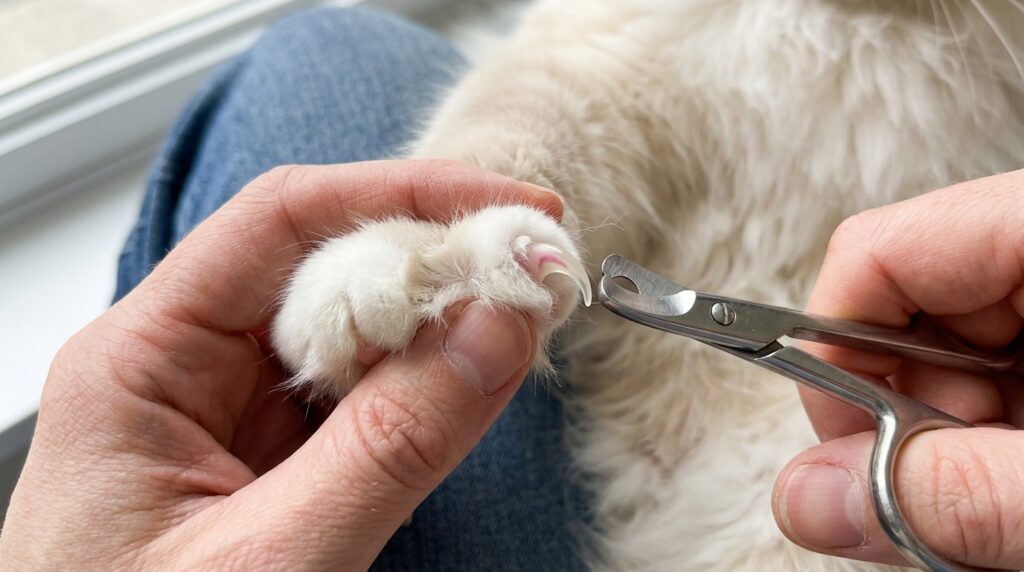
The most important part of how to trim cat nails safely is knowing where to stop. Every claw has a living core called the quick. It contains blood vessels and nerves and looks like a pink triangle inside the claw. Cutting into it hurts and bleeds. On light claws you can see it clearly. Cut only the clear, hooked tip and stay about 2 mm (1/16 inch) in front of the pink.
Cat claws are retracted when the paw is relaxed. To see one, gently press the top of the toe and the pad underneath: the claw slides out.
How to Trim Cat Nails: What You Need
- Cat nail clippers. Small scissor-style clippers are the easiest for beginners. Guillotine clippers also work if your cat has thick claws. Keep the blades sharp: dull blades crush the claw instead of cutting it.
- Not human nail clippers. Cat claws are curved and narrow, and flat clippers can split them.
- Styptic powder (or plain cornstarch) to stop bleeding if you nick the quick.
- Favorite treats or a lickable treat on a lick mat.
- A towel for cats that wriggle.
- Good light. A bright window or a lamp helps you see the quick.

Get Your Cat Used to It First
The secret of how to trim cat nails without scratches starts before the first cut. If your cat has never had a trim, spend 1–2 weeks on short practice sessions. It’s the part most owners skip, and the main reason trims turn into battles. Each step takes a few seconds a day:
- Days 1–3: touch and hold a paw for a second while your cat is relaxed, then give a treat.
- Days 4–6: gently press the pad so one claw slides out. Treat.
- Days 7–9: leave the clippers next to your cat and let them sniff. Squeeze the clippers near your cat so they hear the click (cut a piece of dry spaghetti to make the sound). Treat.
- Days 10+: trim one claw, then treat and stop.
Pick a calm time: after a meal or during a sleepy afternoon, in a quiet room with no other pets around.
How to Trim Cat Nails Step by Step
Here’s how to trim cat nails once your cat accepts paw handling:
- Get comfortable. Sit with your cat on your lap facing away from you, or on a table in front of you. Hold your cat gently against your body.
- Take one paw. Hold it between your thumb and fingers, without squeezing.
- Extend the claw. Press lightly on the top of the toe and the pad below it.
- Find the quick and pick your cutting point on the clear, hooked tip.
- Cut in one quick, smooth motion, with the blades at a right angle to the claw (cutting from top to bottom, not side to side, prevents splitting).
- Release, praise, treat. Then move to the next claw if your cat is still relaxed.
- Don’t forget the dewclaw on the inner side of each front leg. It’s easy to miss and the most likely to overgrow.
- Stop before your cat gets upset. Two claws today and two tomorrow is better than ten claws and a cat who hides every time she sees the clippers.
How to Trim Cat Nails When Your Cat Resists
Plenty of cats pull away, growl or bite the first few times. Learning how to trim cat nails on a difficult cat is mostly about patience and a few practical tricks:
- Trim one claw a day. A full trim over 10 days still works, and your cat barely notices.
- Trim while your cat is sleepy. A drowsy cat on the sofa often allows a claw or two without waking up fully.
- Use the “towel burrito”. Wrap your cat snugly in a towel with only the head out, then pull out one paw at a time. Many cats calm down when wrapped.
- Get a helper. One person holds and feeds treats, the other trims.
- Distract with food. Spread a lickable treat on a lick mat or a plate. Many cats ignore the clippers while licking.
- Stay calm and quiet. Cats feel your tension. Never shout or punish.
- Don’t scruff or pin your cat down. Force makes every next trim harder and can cause injuries to both of you.
- Know when to stop. Flattened ears, a swishing tail, growling or hissing mean the session is over. Try again tomorrow.
If nothing works, ask your vet or a cat groomer. Many clinics trim claws quickly during a nurse appointment and can show you a safe hold.

If You Cut the Quick
It happens to almost everyone at some point. Don’t panic:
- Press a pinch of styptic powder or cornstarch onto the tip of the claw.
- Hold gentle pressure with a clean cloth for 30–60 seconds.
- Stop trimming for today and give a treat.
- Keep your cat calm for a while and check the claw later.
Call your vet if the bleeding doesn’t stop after 10 minutes, or if the toe later looks swollen, red or your cat starts limping.
How to Trim Cat Nails on Kittens, Senior Cats and Dark Claws
Kittens
Kittenhood is the best time to practice how to trim cat nails. Kitten claws are tiny and needle sharp. Trimming just the very tip every 1–2 weeks protects your hands and, more importantly, teaches your kitten that paw handling is normal. A kitten trained early becomes an adult cat that accepts trims calmly.
Senior Cats
Older cats scratch less, especially with arthritis, so their claws grow thick and curved. An overgrown claw can grow into the paw pad, which is painful and easily infected. Check senior cats’ paws every week and trim every 2 weeks. If a claw is already stuck in the pad, see your vet instead of pulling it out yourself.
Dark or Black Claws
Dark claws are the trickiest part of how to trim cat nails, because you can’t see the quick. Cut only the thin, hooked tip that curves down. Look at the cut surface: if you see a small dark dot in the center, you’re close to the quick, so stop there.
Polydactyl Cats
Cats with extra toes often have extra claws that don’t touch the ground, like dewclaws. Check them at every trim.
Scratching Posts, Nail Caps and Declawing
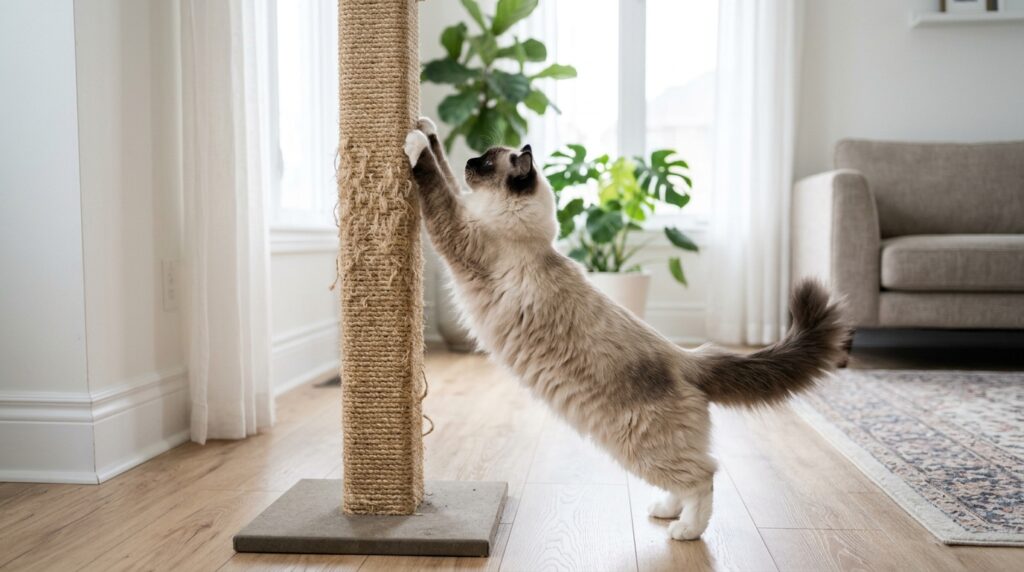
- Scratching posts are a must. Scratching removes the old outer layer of the claw and keeps it healthy. Give your cat a tall, sturdy sisal post that doesn’t wobble, plus a flat scratcher. Put them near sleeping spots and room entrances.
- Trimmed claws protect your home. Short, blunt tips do less damage to furniture, are safer for kids, and help when you introduce a new cat to your household.
- Climbing season. In December, trimmed claws also mean fewer snags on the tree skirt and garlands. See our tips on christmas tree safety for cats.
- Soft nail caps are glued over trimmed claws and fall off with the natural nail after 4–6 weeks. They’re an option for cats that damage furniture or skin, but trimming still comes first.
- Declawing is not an alternative to trimming. It removes the last bone of each toe, causes long-term pain and behavior problems, and is banned in the UK, much of Europe and several US states.
When to See the Vet
Knowing how to trim cat nails at home covers most cats, but see your vet if you notice:
- A claw has grown into the pad
- Swelling, redness, pus or a bad smell around a claw
- Limping or constant licking of one paw
- Claws that are brittle, crumbling or split
- Bleeding that won’t stop after 10 minutes
- A cat so stressed that home trims aren’t safe
How to Trim Cat Nails: FAQ
Can I use human nail clippers on my cat?
It’s better not to. Flat human clippers can crush or split a cat’s curved claw. Small scissor-style cat clippers cost little and make the job much easier.
How short should I cut my cat’s nails?
Only the sharp, clear tip, about 2 mm (1/16 inch) in front of the pink quick. If in doubt, cut less. You can always take a little more off next week.
Do indoor cats need their nails trimmed?
Usually yes. Indoor cats walk on soft surfaces and don’t wear their claws down. Even with scratching posts, most need a trim every 2–3 weeks.
Do I need to trim my cat’s back claws?
Less often. Back claws grow slower and wear down more. Check them at every trim and cut them every 4–6 weeks or when they look sharp.
Is it OK to trim my cat’s nails while she sleeps?
Yes, as long as you’re gentle and stop if she wakes up upset. Many owners do one or two claws during naps and finish over a few days.
What if I can’t trim my cat’s nails at all?
Ask your vet or a cat groomer to do it, and add more scratching posts. Some cats accept trims at the clinic but never at home, and that’s fine.
How to Trim Cat Nails: Quick Checklist
- Cat nail clippers, styptic powder and treats ready
- Calm, sleepy cat and good light
- Claw extended by pressing the toe
- Only the clear tip cut, 2 mm in front of the quick
- Dewclaws checked
- Session stopped before your cat gets upset
- Treat after every claw
- Repeat every 2–3 weeks, senior cats’ paws checked weekly
Now you know how to trim cat nails the calm way: a little at a time, with treats, and never past the pink. After a few weeks most cats stop fighting, and a full trim takes just a couple of minutes.
📚 Sources and further reading